
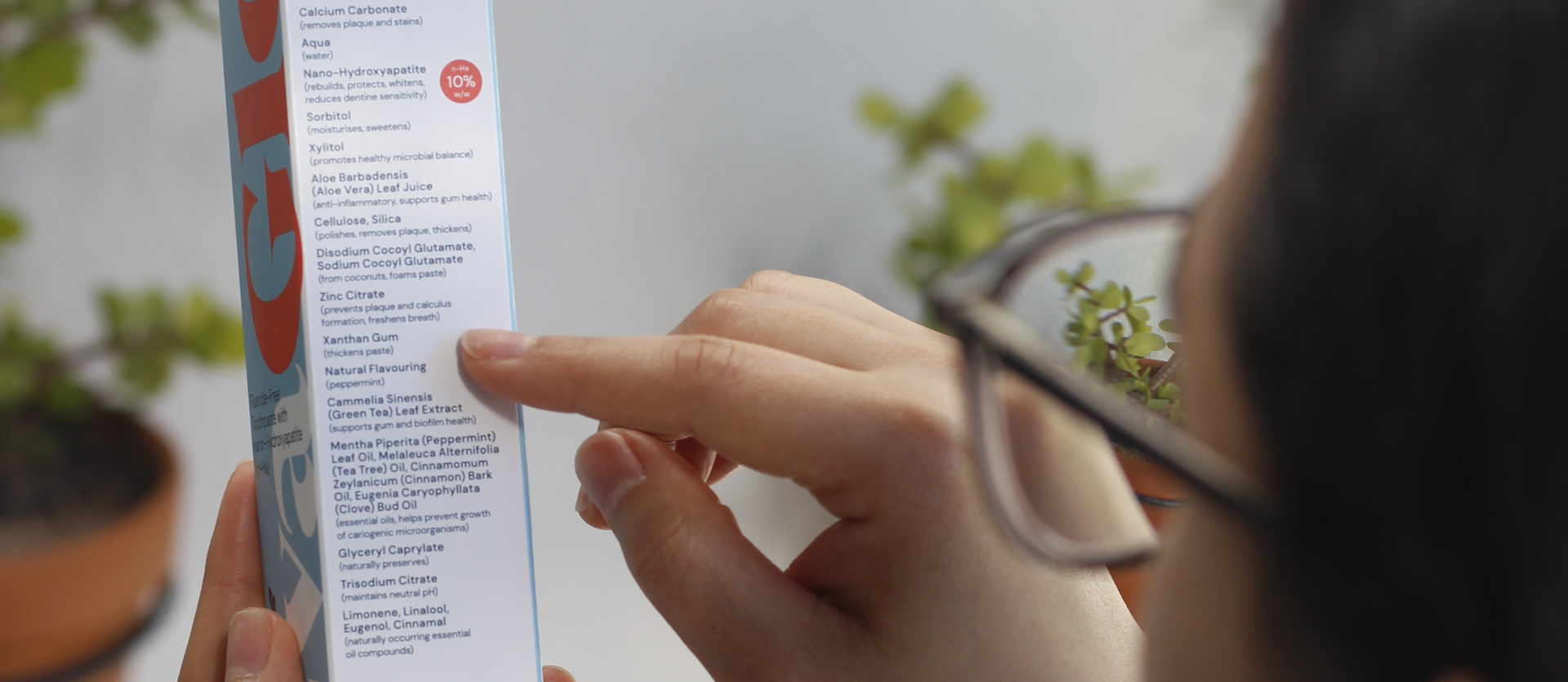
This question generally stems from concern that all nanoparticles are harmful to human health. We appreciate when consumers ask these kinds of questions because we share a similar priority for safety, especially nano-hydroxyapatite safety. EvaGlo was founded with a strong focus on ingredient safety in oral care products. During the development of EvaGlo, we scrutinised a myriad of potential ingredients before settling on the final ingredient list. Therefore, we can sympathise and relate to the concerns that are expressed by consumers, and we appreciate that consumers are conscious of the products that they are using.
In this article, we will briefly address why we chose to use nano-sized hydroxyapatite particles instead of micro-sized. We will also review the four opinions that have been published by the European Scientific Committee on Consumer Safety (SCCS) to evaluate nano-hydroxyapatite safety in oral care products.
Why do we use nano-sized particles in our toothpaste?
Hydroxyapatite has been shown to be as effective as fluoride in toothpaste at preventing cavities from forming. Since EvaGlo is a fluoride-free toothpaste, we chose to use hydroxyapatite as our active ingredient to ensure that our product offered the same level of protection as a traditional fluoride product [1–3].
Micro-hydroxyapatite contains larger particles in the range of 5-10 microns, whereas nano-hydroxyapatite particles are smaller, in the range of 20-100 nm [4]. Although both micro and nano-hydroxyapatite are capable of remineralisation of the enamel to some extent, there are some differences in their capabilities. Particle size influences hydroxyapatite–enamel interactions, with larger micro-sized particles exhibiting limited surface interaction, while nano-sized hydroxyapatite demonstrates enhanced enamel binding and integration [5]. Effective binding of the nano-hydroxyapatite creates more nucleation sites for superior remineralisation [6]. In addition to remineralisation, nano-hydroxyapatite is unique in that it can also help reduce dentine-hypersensitivity and improve the appearance of the enamel (creating a smoother and whiter outer layer) [7–9].
Taken together, these properties informed our decision to use nano-hydroxyapatite in EvaGlo toothpaste. Nano-hydroxyapatite allows us to offer a more effective and holistic approach to enamel care and long-term oral health.
What evidence supports nano-hydroxyapatite safety?
The safety of nano-hydroxyapatite in oral care products is currently supported by the European Scientific Committee on Consumer Safety (SCCS). Nano-hydroxyapatite also has a long track record of use in Japan. It has been used in enamel-repairing toothpastes for decades, and over that time, there have been no widely reported safety concerns documented in the scientific literature or regulatory evaluations [4].
The SCCS is a group of scientists that conducts a risk assessment on the safety of cosmetic ingredients to inform the European Union Commission. The group was formed around 2015 and since then, they have published four opinions on nano-hydroxyapatite in oral care products.
What is an SCCS “opinion”? If the EU Commission requires more information on the safety of a cosmetic ingredient, then it will mandate the SCCS to do a thorough assessment of all the relevant scientific data. The SCCS assesses available scientific literature and data and thereafter formulates an “opinion” on the safety and risk associated with the evaluated ingredient. A preliminary opinion is initially published, which industry members and members of the state are allowed to scrutinise and comment on. Thereafter, a final opinion is published, and it is used to guide the EU Commission on the formation of new regulations or the alteration of existing regulations.
Key findings from the four SCCS assessments on nano-hydroxyapatite safety
Opinion 1 (SCCS/1566/15):
This was the first opinion that was published by the SCCS in 2016 [10]. They reviewed data provided by applicants (manufacturers of nano-hydroxyapatite) and conducted a review of available peer-reviewed literature to determine whether sufficient evidence was available to assess nano-hydroxyapatite safety. They found that the data that was submitted and available in the literature, was limited and insufficient to provide any conclusions on the safety of nano-hydroxyapatite.
Part of the problem was that most available studies did not comply with OECD and EU test guidelines. This means that the results obtained in many of these studies were unreliable and meaningless because the researchers had not followed the correct experimental protocols for obtaining the results. A recurring limitation was that most studies did not specify the characteristics of the nano-hydroxyapatite that was used. Nano-hydroxyapatite (like other nanoparticles) can behave quite differently when particle size, shape, and surface charge differ.
In this opinion, the SCCS concluded that they could not draw any final conclusions on the safety of nano-hydroxyapatite in oral care products. However, they did find that there may be health risks associated with the use of needle-shaped nano-hydroxyapatite particles. Therefore, as a precaution, they advised against the use of needle-shaped particles.
Opinion 2 (SCCS/1624/20):
In 2021, a second opinion was published by the SCCS [11]. After the publication of the first opinion, the SCCS requested that the applicants (manufacturers) provide additional information and data that are compliant with the EU’s experimental protocols. In response, data from compliant in vitro trials, testing rod-shaped nano-hydroxyapatite, was provided.
The standard protocol of the SCCS is to first assess if systemic exposure is a risk. In other words, does the substance enter the bloodstream and spread throughout the body? If they find that systemic exposure is not a concern, then they will progress to assessing if local toxicity and genotoxicity are a concern. Therefore, in this opinion, the SCCS used the new data to evaluate whether nano-hydroxyapatite in oral care products posed a risk of becoming systemically available. In oral care products, there are two routes through which nano-hydroxyapatite could become systemically available: through the oral mucosa (tissue lining the gums and the inside of the cheeks), and through ingestion. Therefore, these routes of exposure were assessed to determine the risk of systemic exposure.
Based on the new data that was submitted, the SCCS found that there was no risk of systemic exposure through either of the two routes. It was found that nano-hydroxyapatite was not internalised by the gingival mucosa (gum tissue) cells, although some did appear outside a superficial cell layer. It is worth noting that the purpose of the oral mucosa is to provide protection to the deeper tissue layers against mastication (chewing) forces, microbes and toxins [12].
Upon assessing absorption through the gastric compartment, the SCCS confirmed that there was no risk of absorption of nano-hydroxyapatite after ingestion. This is because the n-Ha particles dissolve instantaneously in the stomach acid (pH 1-2) to form calcium and phosphate ions [13].
In this opinion, local toxicity and genotoxicity were also assessed. It was found that rod-shaped particles were not cytotoxic and were biocompatible. However, the SCCS were critical of the genotoxicity data that was provided, stating that the test that was conducted was not deemed appropriate for determining the genotoxicity of nano-sized particles.
Although it was determined that there was no risk of systemic exposure or cytotoxicity after using rod-shaped nano-hydroxyapatite particles in oral care products. The SCCS could not conclude on the safety of rod-shaped nano-hydroxyapatite particles until a compliant genotoxicity assessment was complete. Therefore, the SCCS did not provide any guidelines on the use of nano-hydroxyapatite in oral care in this opinion.
Opinion 3 (SCCS/1648/22):
In this opinion, which was published in 2023, the SCCS focused on assessing the risk of genotoxicity as a necessary step before issuing conclusions on nano-hydroxyapatite safety. [14].
In this opinion, the notifier submitted data from compliant in vitro studies assessing the genotoxicity of rod-shaped nano-hydroxyapatite particles. They investigated different parameters of genotoxicity, including gene mutations and structural chromosome aberrations. The SCCS agreed that the results showed that the nano-hydroxyapatite particles did not induce gene mutations or chromosome damage. Therefore, they concluded that rod-shaped nano-hydroxyapatite particles in oral care products were not genotoxic.
Thereafter, for the first time, they offered guidelines on the use of nano-hydroxyapatite in oral care products. They concluded that nano-hydroxyapatite is safe to use in toothpaste at concentrations up to 10%, and in mouthwash products at concentrations up to 0.465%. They further specified that this only applies to nano-hydroxyapatite particles that are rod-shaped, of which at least 95.8% (in particle number) have an aspect ratio of less than 3, and the remaining 4.2% have an aspect ratio not exceeding 4.9. Additionally, the particles should not be coated or surface-modified.
Opinion 4 (SCCS/1677/25):
Another safety assessment and opinion were published by the SCCS in 2025 because industry members provided evidence that nano-hydroxyapatite could be used in even higher concentrations in oral care products [15].
After assessing the data provided, the SCCS agreed that the higher concentration did not induce cytotoxicity, inflammatory responses, or genotoxicity and was well tolerated. Therefore, they concluded that nano-hydroxyapatite is safe to use in toothpaste at concentrations up to 29.5%, and in mouthwash products at concentrations up to 10%.
As you can see, nano-hydroxyapatite safety in oral care products was not adopted or endorsed quickly. It has been examined over many years by the SCCS, which applied a deliberately cautious approach—rejecting non-compliant studies, requesting revised data, and withholding conclusions until the full body of evidence met its scientific criteria.
Conclusion on Nano-Hydroxyapatite Safety
Nanoparticles are not a new phenomenon; in fact, they have been around since the origin of the earth. Many natural foods that have been consumed for generations contain nanoparticles. For example, milk (including human breast milk) contains nano-sized casein micelles, which act as a stable carrier of calcium and phosphate ions, and slow digestion, improving amino acid absorption [16]. While it is true that some nanoparticles may pose a risk to human health, like those present in air pollution, which are derived from road transport, coal burning, volcanic eruptions, and forest fires [17]. It does not mean that all nanoparticles are harmful.
Nano-hydroxyapatite serves as an example of a biocompatible nano material that is not harmful to human health when it is used according to the SCCS guidelines. Before the launch of EvaGlo, significant research was done to find a compliant supplier of nano-hydroxyapatite. EvaGlo sources its rod-shaped nano-hydroxyapatite from a supplier in Europe that is compliant with the SCCS guidelines.
References
- Juntavee, A.; Juntavee, N.; Sinagpulo, A.N. Nano-Hydroxyapatite Gel and Its Effects on Remineralization of Artificial Carious Lesions. Int. J. Dent. 2021, 2021, doi:10.1155/2021/7256056.
- Paszynska, E.; Pawinska, M.; Gawriolek, M.; Kaminska, I.; Otulakowska-Skrzynska, J.; Marczuk-Kolada, G.; Rzatowski, S.; Sokolowska, K.; Olszewska, A.; Schlagenhauf, U.; et al. Impact of a Toothpaste with Microcrystalline Hydroxyapatite on the Occurrence of Early Childhood Caries: A 1-Year Randomized Clinical Trial. Sci. Rep. 2021, 11, 1–15, doi:10.1038/s41598-021-81112-y.
- Paszynska, E.; Pawinska, M.; Enax, J.; Meyer, F.; Schulze zur Wiesche, E.; May, T.W.; Amaechi, B.T.; Limeback, H.; Hernik, A.; Otulakowska-Skrzynska, J.; et al. Caries-Preventing Effect of a Hydroxyapatite-Toothpaste in Adults: A 18-Month Double-Blinded Randomized Clinical Trial. Front. Public Health 2023, 11, doi:10.3389/fpubh.2023.1199728.
- Chen, L.; Al-Bayatee, S.; Khurshid, Z.; Shavandi, A.; Brunton, P.; Ratnayake, J. Hydroxyapatite in Oral Care Products—A Review. Materials 2021, 14, 4865, doi:10.3390/ma14174865.
- Fabritius-Vilpoux, K.; Enax, J.; Herbig, M.; Raabe, D.; Fabritius, H.-O. Quantitative Affinity Parameters of Synthetic Hydroxyapatite and Enamel Surfaces in Vitro. Bioinspired, Biomimetic and Nanobiomaterials 2019, 8, 141–153, doi:10.1680/jbibn.18.00035.
- Amaechi, B.T.; Tan, A.I.; Noureldin, A.A.K.; Kanthaiah, K.; Holladay, E.; Obiefuna, A.C.; Vijayaraghavan, M. In Vitro Evaluation of the Ability of Nanohydroxyapatite Toothpastes to Enhance Remineralization of Enamel Caries Lesion. J. Dent. 2025, 161, 106006, doi:10.1016/j.jdent.2025.106006.
- Shang, R.; Kaisarly, D.; Kunzelmann, K.-H. Tooth Whitening with an Experimental Toothpaste Containing Hydroxyapatite Nanoparticles. BMC Oral Health 2022, 22, 331, doi:10.1186/s12903-022-02266-3.
- de Melo Alencar, C.; de Paula, B.L.F.; Guanipa Ortiz, M.I.; Baraúna Magno, M.; Martins Silva, C.; Cople Maia, L. Clinical Efficacy of Nano-Hydroxyapatite in Dentin Hypersensitivity: A Systematic Review and Meta-Analysis. J. Dent. 2019, 82, 11–21, doi:10.1016/j.jdent.2018.12.014.
- Amaechi, B.T.; Lemke, K.C.; Saha, S.; Luong, M.N.; Gelfond, J. Clinical Efficacy of Nanohydroxyapatite-Containing Toothpaste at Relieving Dentin Hypersensitivity: An 8 Weeks Randomized Control Trial. BDJ Open 2021, 7, 23, doi:10.1038/s41405-021-00080-7.
- SCCS (Scientific Committee on Consumer Safety) Opinion on Hydroxyapatite (Nano); 2016
- SCCS (Scientific Committee on Consumer Safety) Opinion on Hydroxyapatite (Nano); 2021
- Nanci, A. Oral Mucosa. In Ten Cate’s Oral Histology; Mosby, an imprint of Elsevier Inc., 2012.
- Ramis, J.M.; Coelho, C.C.; Córdoba, A.; Quadros, P.A.; Monjo, M. Safety Assessment of Nano-Hydroxyapatite as an Oral Care Ingredient According to the EU Cosmetics Regulation. Cosmetics 2018, 5, 53, doi:10.3390/cosmetics5030053.
- SCCS (Scientific Committee on Consumer Safety) Opinion on Hydroxyapatite (Nano); 2023.
- SCCS (Scientific Committee on Consumer Safety) Opinion on Hydroxyapatite (Nano); 2025.
- Rogers, M.A. Naturally Occurring Nanoparticles in Food. Curr. Opin. Food Sci. 2016, 7, 14–19, doi:10.1016/j.cofs.2015.08.005.
- Portugal, J.; Bedia, C.; Amato, F.; Juárez-Facio, A.T.; Stamatiou, R.; Lazou, A.; Campiglio, C.E.; Elihn, K.; Piña, B. Toxicity of Airborne Nanoparticles: Facts and Challenges. Environ. Int. 2024, 190, 108889, doi:10.1016/j.envint.2024.108889.
